19 January 2015

Best of 2014

Allow the WTT to quote the WTT this time last year:
I am comforted by patterns. 2013 confirmed that in even-numbered years the Giants win the World Series and in odd-numbered years all the best films come out. 
All I'm saying is don't doubt science or my rectitude. Madison Bumgarner gave one of only two onscreen performances I couldn't live without in 2014. (Spoiler alert: If I had not spent a stray Sunday afternoon watching a four-hour Filipino film I might not have even had the will to generate my traditional "Best of" post.)

In 2014, my rapidly eroding patience with our cinema found words in T.I.'s summer jam "No Mediocre."


As is often the case with rappers, you have to see past the T&A, the veneer of misogyny and get to their artistic concerns. T.I. is tired of mediocre shit being praised for greatness and I'm right there with him. As he scans the Billboard Top 40, I scroll down the vista of movie listings, unmoved by the indistinguishable B-average prestige pictures that Rotten Tomatoes encourages one to see (which one is The Imitation Game and which one is The Theory of Everything again?). If what's left for me to love is American Sniper, Boyhood, Interstellar, Gone Girl, et al, I'm at sea, I'm Robert Redford last year--all is lost.

Best Supporting Actresses

The finest seven minutes of actressing in a supporting role were lip-synched by Emma Stone on Jimmy Fallon but I suppose I ought to confine myself to film performances. In Listen Up Philip, Elisabeth Moss's humorous cat ventriloquy is as necessary as oxygen between Jason Schwartzman's wannabe Philip Roth and Jonathan Pryce's Philip Roth. Minnie Driver does some excellent scene-chewing in Beyond the Lights, possibly because her jawline is so pronounced it appears she has mandibles on her like a stag beetle. I'll take a stab at rating the female performances in Inherent Vice which, as far as I can tell, exists only to provide zany supporting roles: 1. Joanna Newsom's voice, 2. Jena Malone's teeth, 3. Katherine Waterston's nipples, 4. Maya Rudolph's wig, 5. Hong Chau's eyeliner (though, in the end, Jeremy Renner wore it better in The Immigrant). But the finest performance is in Ida--Agata Kulesza gives us a character of sublime brilliance and self-hatred, an ideal foil for the young nun at the center of the story. Kulesza makes us feel the utter necessity of pushing the self-destruct button.


Best Supporting Actors

(Best supporting actor is a tough race but worst supporting actor is easy: Christian Slater in Nymphomaniac. Good god, that tree metaphor...)

I admire The Lego Movie because, in a film that is otherwise full of absurd cartoon characters, Will Ferrell gives a stunning bit of vérité as President Business, who would stroll to election in 2016 if only he were a real person. Because I like the occasional nod to actual Oscar candidates, I support J.K. Simmons in Whiplash--I found real menace there, remembering my own arrhythmic terror, not knowing whether I'm rushing or dragging. "Not quite my tempo, no worries." Credit has to be given to Neil Patrick Harris in Gone Girl--you really appreciate his throat being slit (though perhaps that was more about my giddy realization that the film was almost over). To return to the sketch comedy drive-bys of Inherent Vice, props to Josh Brolin, who brought actual heft to the film--I guess I'm voting for his haircut and pancake ordering style. The ultimate kudos go to the genuine chills provided by Stranger by the Lake sex panther Christophe Paou and his fine, fine mustache.


Best Actresses

As with Suzanne Clément in Laurence Anyways last year, Angeli Bayani's performance in Norte, the End of History is so immense I can't even deal. Bayani hit that Falconetti level and may now ascend directly to heaven. Prepare yourself by rewatching The Passion of Joan of Arc, then stream Norte, and then give yourself a couple weeks to recover. Elsewhere, Marion Cotillard's life is somehow even more fucked up in Two Days, One Night than it was in Rust and Bone, even though she didn't have her legs bitten off by an orca. Gugu Mbatha-Raw and her subtly-metaphored theme song "Blackbird," impressed in Beyond the Lights (even if the film is somewhat undone by the fact that her exploitative, faux-Top-40 single "Masterpiece" is a much better song). Charlotte Gainsbourg dragged the second half of Nymphomaniac to some semblance of competence. Congratulations as well to the three young Swedes (Mira Barkhammer, Mira Grosin and Liv LeMoyne) who star in We Are the Best! and elevate what would be a by-the-numbers indie with their closeup camaraderie and hair-based bonding.


Best Actors

I'll just get it on the record here: I think Miles Teller is going to be a great one and Whiplash will be one of his early landmark roles. Macon Blair looks alarming as a bearded and blood-soaked hobo and somehow even more frightening as a pudgy and clean-shaven junior insurance salesman on the lam in Blue Ruin. Still, Blair is handsomer than Timothy Spall, who made a grabby, smudgy, don't-give-a-fuck-y Mr. Turner. In Cannibal, Antonio de la Torre is an exquisite table manners and savage display of appetite type of a guy. He makes me want to be a better man or at least wear better suits (overall he seems like a chill dude and I wouldn't fear him eating me at all). But I'll give the prize in this tepid year to Ralph Fiennes, who at least takes on a big role like a dang ole movie star in The Grand Budapest Hotel.  


Best Pictures 

(But first, a confession of blind spots (I mean, blind spots to films that might have made this list, not blind spots like Into the Woods): Actress, Goodbye to Language, Horse Money, The Tale of Princess Kaguya, Winter Sleep.)

12. Two Days, One Night - The Dardennes have done it--they've made another film that's exactly as good as all of their other movies. This is praise that is also a criticism. Though perhaps if the directors had selected for Cotillard a white tank top rather than a salmon one this would be a couple of spots higher on the list. I still hold out hope that their next Cannes darling will feature hot Franco-Belgians fucking without consequence and eating decadent snacks.

11. Lucy - ScarJo's Lucy is a piece of meat, a human being based on a lecture by Morgan Freeman, conflated via intercuts with an antelope, spattered with blood on her cheetah-patterned coat, intergalactic fireworks before her eyes, following Romy Schneider into L'Enfer or Gaspar Noe Into the Void, restructured genomes like the finest graffiti, her limbs disintegrating into frosted doughnut sprinkles, strings of Matrix code tethering us to our cell phones, the cosmos of Luc Besson, the skin tag spots across Freeman's face. I got my eleven dollar's worth just for Lucy's excellent, direct summation of her motivation: "Someone put a bag of drugs inside me and I need you to get it out."

10. Citizenfour - On 26 December, 2014, I was politically radicalized because of this film. I'm done voting for presidents from the major political parties in the United States. Conscious Americans are all on a path like Edward Snowden's, where the day comes and we have to tell our loved ones, "I can't really speak out loud here." The documentary is depressing on two levels: we are fine with living in a surveillance state and we can't even be bothered to watch this crucial documentary about living in our surveillance state. As always, holler at your boy if you've got a lead on Norwegian citizenship. 

(This feels a little too serious for the WTT so I'll add this: the way Snowden's hair stuck up in the back drove me nuts. I know director Laura Poitras felt the same way because she included a scene of Snowden fussing with his 'do before going on the lam, perhaps for the rest of his days.)

9. Whiplash - Much as this list gives me a chance to allow only one Hollywood film in the top dozen, Whiplash afforded learned critics the ability to reveal themselves as jazz as well as film snobs (talking about you, Richard Brody, hilariously eager to expound upon all the things he's heard and you never will). For those of us who don't know any better, the film delivers pithy artist-at-work kicks and a climax as audacious as the last 15 minutes of The Red Shoes.

8. The Naked Room - This is a documentary film of relentless closeups, shots you'd expect to see in hostage videos, circumstances not unrelated to the children brought before the camera in this anonymous hospital in Mexico. Near the end of the film, one severely depressed teen, Hayde, is asked to promise that she will not hurt herself when she leaves the office but cannot state the affirmative. When she breaks down, she raises her arm to brush the tears from her cheeks and we see for the first time her left wrist wrapped in heavy gauze. It is a heartbreaking moment of grace. She wept, I wept.

7. Mr. Turner - There have been many great metaphors for what Timothy Spall looks and sounds like in his title role. I'm going to go with a lowland tapir in rutting season at the Brookfield Zoo (indelible childhood memory). A big thank you to Mike Leigh who, across decades of good work, continues to remind the viewing public that people over 40 still have sexual intercourse. The brilliance of this film, as with Topsy-Turvy, is not just in the climax (though shouting "The Sun Is God!" on your deathbed is a solid way to go out) but in the diminuendo that sketches the aftereffects of Turner's death, the shittiness for all of us lesser lights when the master's show is over.

6. Rich Hill - Tracy Droz Tragos' documentary is full of Malick, great following shots of cartwheeling kids and nighttime photography of fireworks hanging in the air above Rich Hill, MO. And much of the dialogue is as pungent as Kit's Badlands line, "I'll give you a dollar if you eat this collie." The three boys at the center of the story have surprising areas of knowledge. Harley explains that "you can get mango on food stamps." Appachey (that astonishingly American name!) expresses a stunning career plan: "I was thinking of moving to China...and becoming an art teacher." And Andrew says, wiser about his life in deep poverty, "I have no say in what happens; they're the parents, I'm just a kid." After watching this documentary you'll want to keep up with these boys as much as I do.

5. Ida - Pawel Pawlikowski made the most composed film of the year--without upsetting Wes Anderson I would buy a book of postcards of the shots from this movie first, from the mist on the rural fields to the grill work on dingy hotel windows (note the name of the cinematographer Lukasz Zal). The performances are also excellent: the aforementioned Agata Kulesza's Wanda as the long lost aunt to Anna/Ida, dark of eye, dimpled of chin, the Jewish nun, and the jazz musician (Dawid Ogrodnik) who charms them both, sort of a Polish Pattinson playing "Naima" by John Coltrane. It's the music you'll hear for the rest of your life, saving souls in a nunnery or drinking yourself to death in a Lodz apartment. 

4. Stranger by the Lake - Apparently the only sexy movies this decade are from France, far away from the Hollywood's flaccid, anti-dream factory. The death spiral attraction between Christophe Paou and Pierre Deladonchamps emphasizes the lengths to which I need to step up my mustache AND chest hair game. The film revels in the claustrophobia of only ever being at the lake and never indoors. The delirium of lust and cum in the afternoon is slowly replaced by fear in an endless dusk, enough to make the rabbit wish to be caught. Strangers builds to a climax that made my hair stand on end. A voice calls out, "I won't hurt you."

(Gillian Flynn and David Fincher are assuredly already plotting a ruinous Hollywood remake.) 

3. The Grand Budapest Hotel - The seventh best Wes Anderson film is still the third best film of 2014--it was that kind of year. Bu that doesn't mean Grand Budapest isn't excellent. As Ralph Fiennes' M. Gustave knows, the rudeness of Wes Anderson haters is merely an expression of their fear. I can only offer a rueful smile at someone who would take something as sumptuous, as beautiful, as well-crafted as a cake from Mendl's and say, "I don't like it, it's too sweet." 

2. Under the Skin - Scarlett's Johansson's Renaissance year allowed me to revisit a WTT post from 2008 (before the tabloids had even settled on ScarJo as a nickname!). It's a time capsule of my early approach: more pictures, more discussion of boobs. What's happened since? A tragic amount of films with colons in their titles. Iron Man 2, The Avengers, Captain America: The Winter Soldier and the impending drivel called, and I don't exaggerate: Avengers: Age of Ultron and Captain America: Civil War. This lucrative dross is interspersed with failed comedy vehicles He's Just Not That Into You, We Bought a Zoo, Chef and Hitchcock (that was supposed to be funny, right?). She's had, for ten years, a distinct inability to pick auteurs (Jon Favreau does not qualify). 

In popular conception, actors read scripts (or actors' assistants read scripts) to select their next films but what I'll always wonder is why they don't just choose by director. Juliette Binoche works globally, with the finest directors, and has had the best career of anyone in the past 25 years. How difficult is it? When Johansson finally arrived at Besson and then Jonathan Glazer this year there was a respite from the suck.

Like Stranger by the Lake, Under the Skin will discourage you from spending time on rocky beaches.
The best parts of the film are documentary, with non-actors being talked into a van by a very attractive someone they don't know is Scarlett Johansson. The ridiculous, porn setup dialogue shows us the bottom line--a Celtic fan will get into a car with ScarJo for any reason. The sexy voice, the trashy clothes and dull men willing to go to their death after that ass. A gorgeous sadism pervades the piece, as if Frederick Seidel decided to direct a picture. When her 20-film deal with Marvel expires, I hope ScarJo will take a ride with more auteurs.

1. Norte, the End of History - For director Lav Diaz, a four hour film is shortform. But this is slow cinema so good that I didn't need to check my cell phone, I didn't need to urinate. Norte is not just the longest film on the list but the most profound and, moment to moment, the most beautiful. Diaz begins with an adaptation of Crime and Punishment but far exceeds Doestoevsky in artistry. 

To quote Fabian (Sid Lucero), the film's protagonist, whose murder of a moneylender is the least of his problems, "How can I be at peace with the world's shallowness?" Joaquin (Archie Alemania) goes to jail for Fabian's crime and leaves his wife (the Falconetti-channeling Angeli Bayani) to survive without him.

To select a single sequence to set the mood: a long shot of a window propped open pre-dawn, insects whispering, a cock crowing, the putter of a motorbike that stops and allows a woman out, bags of vegetables piling on a cart, a dog observing, a younger sister appearing, a cooperative effort. A cut: the sky is lighter, bluer but it's still early, we look over the river as the women arrange the vegetables on the cart, trying to work the kinks out of their sore shoulders, a goat wanders by, a young daughter appears to help, they discuss the dawn of another day, their endless work.

As I wrote in my notebook many times, wow, wow, WOW. The digital camera is so crisp and bold you can't believe there aren't special effects involved. But it's just the blockbuster of Diaz's imagination. In the last hour you might ask yourself, as Ian Darke has deep into World Cup stoppage time, "how much more of this can their possibly be?" but the payoffs keep coming. This gorgeous suffering, this epic accomplishment.

Lav Diaz: no mediocre.

21 September 2014

Retreat


"You are in Joy."

And so I enter New Clairvaux Abbey's guest room #2. The most desperately pressing question of my no technology retreat is answered at a glance: yes I have a private bathroom. I refrain from fist pumping because monasteries are holy places.

I spent the Sunday before I got to Joy in Sonoma. I wanted to ease my way in to four nights of no cell phone/internet/television by going to a place where sometimes I don't get 4G reception. My aunt brought me to Jack London State Historic Park, which is a more appropriate but less romantic name for the 47.5 acres than the original: Jack London Home and Ranch. With apologies to my readers who are big fans of the WTT and White Fang, London seemed like a real asshole, the sort of socialist with a fascist's emphasis on physical strength and a racist's unpleasant fixation on "lesser" peoples. But he had a hell of a nice home and ranch, even if the landscape is marred by intermittent stands of eucalyptus (a fake cash crop sold to London by enterprising Australians).

London wrote many books (amazing how fast they come when you write 1,000 words a day) in his cottage as he waited for the great Wolf House to be built. His mansion burned down a couple of weeks before it was set to open—chemical soaked rags left in a closed room conspired to build a fire. It would have been beautiful, a two-story stone horseshow surrounding a reflecting pool, but his insurance wouldn't cover all the costs of reconstruction ($80,000 in 1913). So he left the ruins to the woods and went back to his comfortable, Polynesian-grass-mat-lined cottage and wrote and drank some more and died on his sun porch in view of a tremendous oak tree in the front yard. This tree is so goddamn Californian it ought to be on the flag of the republic, somewhere behind the grizzly. I’m devastated because my aunt say it's dying—it gives off light like a dead star. 

 
Day One
On the way into Vina, CA, the hamlet nearest to New Clairvaux, the landscape changes from green vines to dust and semi trucks. There are fewer Dean & Delucas. Stopping in Williams, I hear an unsettling statement in a gas station parking lot: "I feel like I'm in that movie No Country for Old Men." I pull back onto the highway past the Liberal Ave. exit decorated with a handcrafted "Obama Must Go" sign. Closer to New Clairvaux, quarter-sized drops of rain sprinkle intermittently.

I enter the abbey through a side gate and a green cloud of oleander, my hand already shaking from desire to flip my phone back from airplane mode, for one last text, one more Twitter refresh. In the Welcome Center I find a "Back in 10 Minutes" notice and consider driving home. But I stand and watch watercolored koi lap around their fountain in front of the guest chapel, shaded by storm clouds taking turns with bright sunlight.

Guestmistress Michelle arrives full of dread-lifting friendliness. She chirps "Kirk!" then leads me to a cheap-Badlands-motel cinderblock structure (as my aunt remarked when we were browsing the online gallery, "would it kill them to put up some drywall?"). Perhaps the guesthouse has been made deliberately drab to enhance the beauty of the mature walnut, pine and Italian cypress trees dominating the grounds. (I’d name a lot more species if I knew their names—how does John McPhee know all the damn trees? Does he spend time outdoors? Ask better questions?) At the end of our tour, Michelle says there's no option but to stay through Friday and, thanks to her kind, dark-dotted green eyes, that doesn't even feel like a threat.


Beyond the windbreak of trees outside Joy’s window there's a fallow field of long, browning grass. This room, with its thin seafoam bedspread and institutional sheets, makes me nostalgic for my grad school dorm, windows wide open and bad weather driving over the hills. I could listen to Fleetwood Mac's "Storms" and have some tears but I'm learning to say no to technology. Also, the lyric "not all the prayers in the world could save us" is rather inappropriate for this setting.

As I make my way to a dinner Michelle termed "modest," the oleanders are writhing, redolent with what Frederick Seidel calls the delicious smell of rain before it falls. I almost step on a cat called Lucious, who is blind and has white eyebrows—a cliché of a monastery cat. The lights are off but this must be the dining hall, St. Luke's (note to self: google St. Luke in four days (the Patron Saint of Artists!)). The wind rattles spooky sounds into the dim back kitchen. Dinner tonight is cream of broccoli—I'll have to tell the maître d tomorrow that I prefer something along the lines of a bisque.

For Cistercians like the brothers of New Clairvaux, the large meal is at midday and the rest are light. I cherrypick clumps I think are potatoes and learn that cocktail onions are the devil's work. Dessert is listed as "cantaloupe!" because monks enjoy sick exclamations. Long thunderclaps get tangled in evening church bells. I seat myself so I face both points of entry, knowing I will jump out of my skin if anyone enters unnoticed. A robed brother flits by on a bicycle, completing the horror story motif. I hustle back to my cabin thinking we have scars on our imagination that come from joy.

When Michelle told me she hoped it wouldn't be all thunder and no rain I thought she was being silly—as Stevie Nicks will tell you, thunder only happens when it's raining. I see lightning strikes and trees bent over in the gale but no precipitation. It sounds like an echoing jet plane and the undercarriage of a gravel truck and I have no idea when it will pass because my phone is in airplane mode. Does Lucious feel the rumbling under his white eyebrows? 


Day Two
After learning that I’m vacationing in a place with no television, phone or internet friends have one question: Why would you do that? Beyond the actuality that I am a poor person who likes to be alone, I’m doing it because of Patrick Leigh Fermor. When you take your own monastic retreat, don't leave home without his excellent short book A Time to Keep Silence. He writes, "I was, in fact, in search of somewhere quiet and cheap to stay while I continued to work on a book that I was writing." And he had to have been talking about Twitter when he wrote of "the hundred anxious trivialities that poison everyday life." With Fermor’s help the question is easily reversed: Why would I come back to the larger world?

Fermor details the funny attire of monks but, though I look carefully, I haven't spotted a single hairshirt. Perhaps I can't really tell—the New Clairvauxans’ commodious robes don't show underwear lines. Rereading A Time to Keep Silence makes it clear that I have conflated two orders—those with more intellectual than ascetic bents may leave the Trappists (New Clairvaux is such a brotherhood) for the Benedictines (who have all the fun).

"Life, for a monk, is shorter than the flutter of an eyelid in comparison to eternity, and this fragment of time flits past in the worship of God, the salvation of his soul, and in humble intercession for the souls of his fellow exiles from felicity." That's a bit heavy Paddy—it's only breakfast time for me, about four hours after the monks were up celebrating Vigils at 3:30. 

Lucious, like most felines, is capable of great speed over a short burst. In the shaggy grass, he pounces amidst the grey squirrels that parade the grounds. They have a tendency to wear their tails high, dipping them over their sharp faces like veils. I am joined at breakfast, reluctantly, by two women with a stockinged nunniness about them. One is tall and glaring, the other short and beatific. The latter manages a "good morning" but her friend does not speak beyond a few hissed phrases in Spanish. I think of her henceforth as The Stern One (La Popa).

The terminology Fermor uses for the Gothic buildings in monastic France is baffling but I can't imagine he would be much impressed by the constructions at New Clairvaux. The guest church out the window is notable for the persistent cinderblock, small inset windows and roof of red shingle trimmed with Spanish tile.

The only point of architectural significance I find here is the Sacred Stones. In 1931, William Randolph Hearst had a Cistercian chapter house in Ovila, Spain dismantled and shipped back to California on eleven boats. He needed the rocks to rebuild his mother’s estate, Wyntoon, after a previous iteration burned to the ground. Hearst’s plans changed and in the end he never even picked up his shit from Golden Gate Park, were it moldered for decades. Eventually some dignitaries (including noted insane rich person Dede Wilsey) gifted the stones to New Clairvaux, unmarked, with no IKEA instruction manuals/allen wrenches. To catch up with all the goings on, I recommend this terse timeline of woe.

What the friends of the monks have erected so far is completely open on one end and oddly finished with iron girders and cinderblock (again!). They probably ought to solve for the birdshit in the oculus windows. Still, the space is compellingly Instagrammable, totally empty. 


In the guest library I see the name Thomas Merton over and over but never find The Seven Storey Mountain, a book I wanted but couldn’t find in time for my trip. There are at least two critical studies of it. Some of the religious titles are unintentional giggles—Touched by a Saint—and others generate derisive snorts—Schindler's List. But the overall catalog is good: from the illustrated Thucydides to Bill Bryson's A Walk in the Woods and if not The Power and the Glory, at least's there's Graham Greene's Monsignor Quixote. Greene begins with a satirical vignette on a bishop entirely occupied with the matter of imbibing wine. Even surrounded by monk-tended vineyards, I wonder if such blasphemy is suitable. Perhaps this is the enfer, an area Fermor mentions as the shelving spot for books banned to the main population of monks.

I'm certain that my mother would want me to be on the lookout for a future life partner, as nothing screams single and ready to mingle like vacationing at a donation-only monastery. Given the rather advanced age of the ladies spotted so far at New Clairvaux, a veritable sexpot enters the dining hall as I'm about to shove off after lunch. I pause for a moment but she takes a cell phone call and everyone else in here surely agrees that she should be ejected from the grounds.

A big part of one's spiritual health is physical labor, so I take the hike Michelle recommended when I arrived. I walk west down the South Road because the North Road is off limits, the exclusive provenance of the brother monks. Those fatcats get all the shade and non-cinderblock buildings on the upper campus. Even though it’s 90 degrees I'm happy to be out amidst the companionable whistling of the disrobed farm workers and the jerky circling of turkey vultures. The path goes from asphalt to broken pavement to gravel and here I am. Deer Creek, 30 feet below me down a sheer mud bank. The water looks so cool. My friends know me as an expert bushwhacker but, following the example of the peaceable monks, I didn't bring my machete. I head north, seeking a clear trail down to the stream. I pick my way through brambles until I find the path to salvation the way I always have: by the reflective glare of a beer can. The Bud Light Lime breadcrumbs lead me to a fetid finger of the creek but I wouldn’t make it to the main body without getting knee deep in the muck and compromising my only pair of shoes.

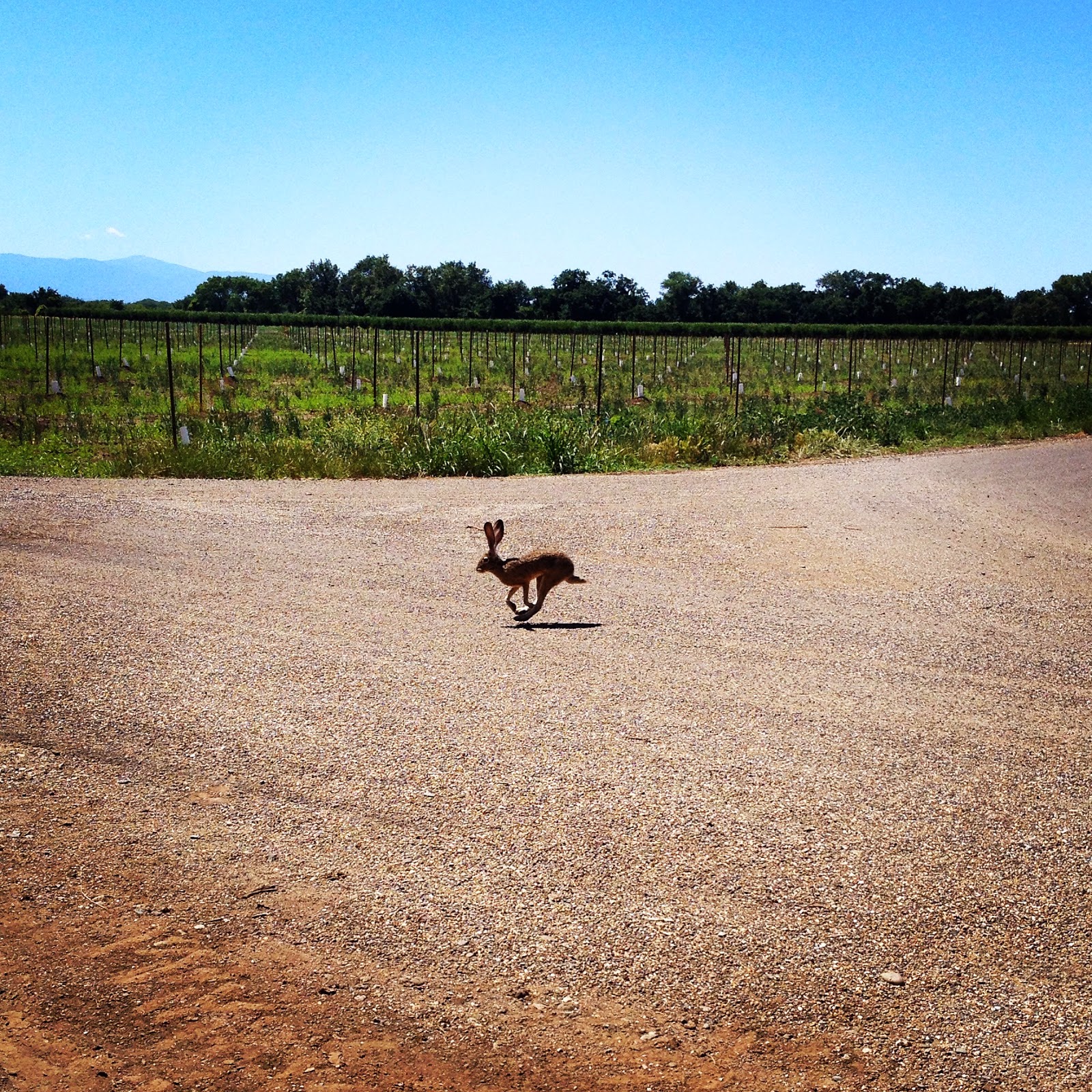
My sweaty despair is mitigated by a field full of blue-black butterflies with eyes on their backs like the cover of The Great Gatsby. In the understory of walnut groves lope fawn-sized jackrabbits. The big two-hearted oak in the middle of the guest campus drowses up and down. Smelling supper from the outside I fear another round of cream of something but the result is much better: fried potatoes. The Stern One strolls in and gives me what seems to be, but surely cannot be, a malicious smirk. She waits for her friend, who enters with a spry septuagenarian. They've weaved some lovely fabric key chains and I'm furious I wasn't invited to that workshop.

But the new, non-nun arrival offers me half of the pear she’s slicing and tells me she's an atheist. When she scores a Kraft single from the fridge and offers to split it, I want to ask her to be my grandma (I could use a replacement). Elizabeth is on vacation from a husband with Alzheimer's and says her new goal is to get away every fourth week. This takes planning, as the man does not like to be left with "young girls." This is not her first monastic rodeo—she’s taken a nine-month walking trip over southeast Asia with Zen peace monks, drumming rhythms at victims of genocide and water buffaloes. Furthermore, she explains that she's composing poems while retreating—she finds it easier to capture stray thoughts without the demands of prose. Don't I know it—I want to tell her, "it sounds like you've just grasped the nature of the poetry MFA student." She says that on her walk today she saw the same huge jackrabbits I did. When she mentions spying a heron or egret I fear we're approaching a Mary Oliver moment but blessedly it never comes.


Day Three
I begrudgingly admit that the best-dressed person at New Clairvaux is The Stern One, with a new habit color every day: crisp white to deer brown to blushing violet. The wheat bread for breakfast has the heaviness of penance and you could use a loaf of it to bludgeon a zombie monk if it came to that. I struggle to finish my portion even after slathering it with monk-approved JIF peanut butter. The Stern One's contemptuous gaze follows me to the door and I feel like shouting: "I haven't even masturbated since I got here!"

When on retreat you can read a book a day and today brings me to J.A. Baker's The Peregrine. He belongs to my favorite species of writer—the wildly talented recluse—and, according to the NYRB introduction, we are not even sure when or where the man died. But he wrote the best book I have ever read about the peregrine falcon, and probably the best on any raptor.

Baker’s impressive, obsessive diary follows a pair of falcons through his native Essex. October through April, he walks the orchards and fields of his home range like a current underneath the birds, easily covering a dozen miles a day. A peregrine weighs between one and a half and two and a half pounds; its eyes are the same size as ours. As he describes them, the hawks are ideal artists: "the peregrine sees and remembers patterns we do not know exist." Baker's language is so unusual and pungent that I'm sometimes unsure if the words are verbs or nouns or British bird names: "the tiercel raced away to the east through snaking lariats of starlings."

The writing is violent and very much like James Salter's flying memoirs—Gods of Tin is also written in diary form—and this makes me ecstatic. "He stared down at the hand-sized earth that had drifted by beneath him so slowly every time before. Now he seemed to be crossing it with great speed, as if running with the current of time. Ribbons of ocher road, highlands and villages were all floating swiftly out of sight under the wing. He felt an overwhelming, captive sadness. It was his farewell."

Baker makes constant use of metaphor but all the comparisons are related to other things he finds in the wood. Coastal East Anglia is a self-contained universe of meaning. "Light shines in woodland hollows, like still water. Birch twigs are a winish haze. A cock brambling calls, a grating nasal 'eez-eet,' bobbing and flicking his tail. His underparts are orange and white; glowing orange, like a sunset on silver scales of birch bark. A bounding flight of redpolls ripple out their harsh and tangy trills, hang upside down, dip deep into birch buds, then bound away. A redwing flits through the trees. Straw-colored eye-stripes make its eyes look slanted. Its red wing-patches are like smeared blood." The color, the assonance, the metaphor: masterful.  

 
I look at the door to the meditation room and know I need to go in and ruminate over what to do with my life but I keep putting it off, wishing the monks had felt a stronger need for a sauna or indoor pool. My aunt told me I could mediate if she could meditate but I didn't ask follow-up questions as to how one does it. The chamber is small and looks into the pulpit of the guest chapel. Finally I sit down in a crossed-up lotus, clasp my hands and close my eyes.

At first I draw inspiration from the green and gold rug underneath me, the decadent crosses and moths gliding over sparkling water. I breathe birds into motion, my deep heaves the forward and backward sweep of tide. I am walking the strand as a curlew, a dunlin, and then I'm metal-legged and digging my beak into the sand, an oil derrick unaware of any raptors. I want to know what to do with my life. What I repeat is: I am 31 years old. I follow it with I'm unhappy and I want to know what to do next and it's May then June then July then August the September and I must change my life.

The tide rises, covers me up to my chest. Because my legs are falling asleep or because of something else my extremities tingle. I rock in my posture, trying not to spasm. I am sucked out into the ocean and struck by lightning or a peregrine falcon, ready to leap back to my feet with a snapped neck but the limbs won't cooperate. I am in a rush of visions and still calling to the wind I am 31 years old, my numb hands cupped before my face. The electrical current continues underneath me—a live wire touched on a sheet of ice. 

I leave the room with my hands shaking too hard to write. I try to compose myself on the bench beside the door but the cool wind adds to my trembling. To use the proper religious term, I had "a bad trip."

On my walk to Deer Creek I follow a great blue heron stalking through the shadows of walnut trees. He is bothered when I get too near him and flies ahead, but never far enough to lose me. After a half mile he figures out he can fly back the way I came and avoid my irritating gait in his periphery. If you can believe it, I swear there’s a peregrine falcon above me, or some other bird gliding with greater elegance than the vultures.

I'm back at the shelf over the creek, still stuck up top and bitterly considering the monks frolicking in the cool waters downstream. This time I walk to the south, trampling across thick foliage, frightened as ever of stepping on live snakes or dead hobos. Even though I can hear the water, there's no clear path to it. Only on the way back up do I spot the skull and crossbones Hazardous Area sign. Should I beware of pumas? Cottonmouths? Nude friars?

It's the hours after dinner when I would like to, with all due respect to the simple life, just watch a damn movie—perhaps a monastery-related favorite, like Into Great Silence or Black Narcissus or Robin Hood. It amazes the way that, when one strips away the phone, the internet, the television, the magazines and the books, the best form of entertainment left is writing. I write two pages of novel-like matter a day instead of one (or half of one or none) and even compose letters for a lark. 

 
Day Four
I don't mean to blaspheme but you can treat Laszlo Krasznahorkai's Seiobo There Below just like a bible, savoring it over and over. It’s one of the ten books of my life. I came a bit late to Krasznahorkai the writer (and never realized that he wrote all those Béla Tarr films) but from the first time I read him I was hooked, addicted to the avian stillness of the Ooshirosagi, and desperate for Seiobo to come out in full. Krasznahorkai writes about people with obsessive devotion to their crafts—there are chapters on monks preserving a Buddha statue, a Noh actor completely given over to his performances, a dying monk who steps out of his body and circles his surroundings like a hawk and, most crucially to me, a section called "He Rises at Dawn." It is the story of an artist, a man who spends each day making minute changes to Noh masks he carves in incredible, supernatural detail...painstaking is not a strong enough word for it.

This morning I read the chapter "Distant Mandate," about a man driven to vertiginous collapse by the complicated beauty of the Alhambra. "No, it is not at all a question of these specific writings but of a language, arranged out of the so-called girih motif based on the pentagon, but in any event, an inaccessible language rendered from a geometry sacredly conceived; which at first one experiences as pure decoration and considers as a form of ornamentation assembled from tiles or engraved or pressed into the stucco, and at the beginning it really is possible to be satisfied with the impression that this decoration and ornament, because the dizzying symmetries, the suggestive colors—not only the plentiful but simply immeasurable glittering form-ideas—do not leave behind themselves any questions or uncertainty..." This is masonry done in parallels so intricate that they were only discovered and mapped by mathematicians in the 1970s. There is art beyond our understanding in words and stone, patternwork that is a gigantic unity holding together a world falling apart into chaos. 

My second go around in the meditation room is better. I begin again as the Ooshirosagi, gliding a course over field and stream then landing in silence to find fish under a horizon shimmering with heat, undulant water melting in quilted patches. I step slowly into the future. I commit to two paths: a 9 to 5 that offers some meaning and an early morning hour dedicated to real writing work, every day. The resume and the CV. The Ooshirosagi hunts on land and water, at dusk and dawn, strong enough to wait out the day with its neck cricked like under-faucet plumbing. This is the passion of Krasznahorkai and Anne Carson, the ripples in Fitzgerald's golden bowl, each lifted to my lips. The ennui of regular employment is enabling my own laziness against greater labors. I put my head down and pray to the pen crossed over my journal. On the inside of my eyelids strings of Alhambra script fall like rain.

My fascination with Deer Creek comes to an end. Walking a new route along an irrigation ditch I'm often startled by the small movements of alligator lizards, stoned in the sun until goaded by my footsteps. I come to the end of the trench where there’s not so much as a view of the creek. Just that taunting water sound. As I turn on my heel I see a snake, poised five feet to my right. I think of Willa Cather’s My Ántonia, the crowning Midwestern glory of driving a spade straight through the neck of a vicious serpent. I think of the bravery of my Minnesotan forebears and how I can honor them now.

Not really. I immediately squeal, "Jesus Fucking Christ!" and leap as far as I can to my left. After a couple wobbly-ankled steps in tall grass, I hop to the bottom of the ditch and sprint. I know from the nature documentary Anaconda that the key is to put as much space as possible between the beast and me. I wish I'd thought to start a stopwatch to measure my time in the 400-meter dash to the main road (wind-aided, but with backpack). I’m uncertain about the species of snake—it did not have a viperous head or rattle but rather a curious expression and smooth belly: yellow as my own. I'm happy to retreat to the friends of St. Patrick.


So pleased to be alive, in face, that I attend Vespers, at the cost of putting on proper pants and hoofing it to chapel. The building is cross-shaped and particle-boarded, a less appealing version of a high school gymnasium. About ten monks file in, one in a motorized wheelchair, one with a walker, all a little deflated. A Methuselah-bearded old timer makes sure I'm on the right page in the prayer book. Proudly, I've already found Thursday Vespers. But it turns out I'm facing the wrong direction in my seat. I have an eye toward an icon, a candle and a small cross, but the action is on the other end, dominated by a large Byzantine-looking crucifix. Music pours from a dolorous keyboard, the prayers are muddled and the singing subdued. I feel a creeping sadness turning the worn pages of the book. We come to the afternoon reading, some blather about Sodom. All the things that make me gloss over the capital-B Bible are present: random destruction, incomprehensible judgments, a weird fixation on units of measure. Ten percent of Sodom was destroyed in an earthquake and I’m reminded of the absurdist sci-fi storylines Chow-san concocts in 2046—this is the closest I've come to a blockbuster film all summer. Why didn't the holy men sit and outline before committing to this mishmash? After a few more hymns we end on the Lord's Prayer. This one I get—I bow and pray and don't even recite it as Hemingway did in "A Clean, Well-Lighted Place."

Anon in the dining hall we're passing around copies of the book written by New Clairvaux’s Brother Paul. He went the self-publishing route down Mexico way and the resultant errata page is impressively long. He says they got all his words between the covers but not necessarily in the right order. Glancing through The Hermit Bird's Song I wonder over my own self-publishing future, the freedom he felt to mix prose and verse, quotation and original material.

Elizabeth tells me that local herons hunt the koi in the sanctuary pond (she pronounces koi in two syllables, as you might in the East). New Clairvaux has attempted to mitigate the poaching by employing a scareheron to intimidate the real ones. I thank her for the hospitality this week and we wish each other the best of luck.

At my new friend’s suggestion, I step outside to watch night fall, for the Silent Light of it all. Or to demand more from the sunset, as the lady said. It's the best show on tonight. From the plastic chair in front of Joy I see red roses and a burnt orange pickup and a brick wall in medium to extra long shot. Under the lone cypress in this stand of pine a white statue turns grey. The placards on statuary here are for the benefit of the donators, not the folks who can't recognize their saints. Birds chirp. Dogs have a disagreement down toward town. A summer evening on Earth. Yellowing sky, the clouds stretched thinner and thinner. The train. All the monks are asleep. If not, they'll regret it at 3 AM. Or I mean I would. They've probably gotten past all that. This is the most pleasant 90-degree day of my life. More orange in the clouds. A chickenhawk floats overhead. I have wasted my life. Just kidding, and maybe James Wright was too. The sunset is ending as it does for so many of us across this great land: listening to a middle-aged woman coo baby talk to a blind cat.

Clouds reduce to grey, white and indigo—languid dolphins. Those monks with their prunes and walnuts, regular as all hell. The splash of the fountain and first cicadas. The sky is violet and piled with snowy peaks. Tomorrow I will be back in San Francisco, what Fermor calls "the outside world of bounders and sluts and crooks." Krasznahorkai’s Prison of Complexity. The snake sleeps somewhere out in the fields (not that I don't check for it under my feet every 30 seconds). The single bulb outside my room casts an amber light that makes me ache. I know why it does this. I once sat outside the door of a motel next to Zion National Park. That trip I meant to buy tomahawk turquoise earrings for a girl I was in love with out of all proportion. "I wanted her to want me so bad it hurt." I’m overwhelmed not by God but by beauty. The stillness of the Ooshirosagi in the shallows of the creek, eternally hungry, waiting for a fish to rise. 


08 August 2014

Continuations on a Caribbean Note

Can I get past the thirty thousand word mark on my novel? Not without desperate struggle. Can I type five thousand words on my phone on a seven day Caribbean cruise? Absolutely. I've published the heart of my Caribbean tale over at Hazlitt. After you've read that adventure, enjoy the outtakes below. 

 
On one's literary influences:
Armed with Patrick Leigh Fermor's The Traveller's Tree: A Journey Through the Caribbean Islands and with the memory of David Foster Wallace's "Shipping Out" never far from my mind, I record my adventures on and around what captain and crew unerringly referred to as "the stunning Crown Princess." If you're pressed for time, you're probably better off reading the DFW because my impressions are nowhere near as well-written and because his cruise ship takedown from the mid-90's, with the references to throwing himself off the top deck, wrist-slitting, etc. was the first piece I thought of when I heard he'd killed himself. It all might have been different had he gone on a luxury cruise with his parents, as I did...

On the scene in Port Everglades:
DFW has overcooked it a little to compare the baggage claim scenes at FLL to the fall of the Berlin Wall and Saigon--in the same paragraph!--we proceed without issue to a fast cab line (fast when compared to the queue outside the Chili's Too). Though if they're going to call it Port Everglades it ought to have more orchids and alligators. 

Stepping onto the greenhouse of the ship's gangway, I see a smaller point of entrance underneath ours. Is there a status beyond Platinum? Yes. Elite is for the people with 16+ cruises under their belts, the people who may have their shoes shined as many times as they want--until the bootblack's arm falls off--at no additional cost.
 
Standing in front of me is a pair of line jumping, non-Elite cruisers who are notable for a) their youth and b) the two cases of diet soda they are carrying as hand luggage. The young gentleman, in an elaborate faux hawk overlaid with a brand new Red Sox hat, tries to step past more patient people while his giggly girlfriend, though also anxious to "get this party started," holds him back by his tank top.

 
On one's dining companions in the Botticelli Dining Room:
Our fellow traveler Richard is very upset about the narrowness of the roads on the Isle of Wight. He is, as his delightful wife Barbara says jollily at least once an evening, "not well." There is some sort of indentation on his forehead that one suspects is a manifestation of his difficulty. It's quite rare that I am significantly larger than another adult man and, as such, I want to kiss Richard right where that kindly English doctor has been perforating his skull. He has a better hit percentage on witticisms than I, though they are dispensed more rarely. He has sailed the English Channel in his own boat. At the Indian restaurant in his town, Poole, he always orders the Meat Madras, for which he gets a 10% locals discount.

I am put off by the incredible length of time it takes for the remaining couple at the table to say the words "Rio de Janeiro." The husband has enough money to send his brittle-looking wife to a surgeon who's shaped for her a little ski nose, it's very 80's. I am not a gifted conversationalist but it seems an outsized struggle to converse with two people from Rio (where I've been) about Brasil in general (which I love).

At a certain point you look around the table, into the souls of your fellow cruisers, and decide whether they have the intestinal fortitude to do six more nights of two-star conversation and five-star dining. We murmur to ourselves that the couple from Brasil will not be back. They are not back. 

On the scene at Eleuthera:
As our humid tender putters along, we listen to a man who could only be from South Florida. His tan is total and he has a built-in armrest over his waistband. He is the hero in his own story about a previous jaunt to the Bahamas that involved outswimming a rip current while his indolent wife sipped piña coladas onshore. My mother does well to press him, earning the admission that he panicked at first, swam in the wrong direction and was 40 lbs. lighter on the day in question.

Later, as I walk through the reef, an older lifeguard presides over the point of rocks above me, singing to himself under a grey handlebar mustache. He is in different rhythm than the steel tinkling of "No Woman, No Cry" ashore. We observe the still gulls on the rocks, their beaks open and soundless.


On writing at sea:
The desk in my cabin faces opposite the movement of the boat but if I crane my neck I can see out the window into a blinding sun, the ocean a dazzled tinfoil edged in gold. When it comes to stateroom accoutrements, I always grab the small notepad while rejecting the pen (ballpoint, ew). The Princess Cruises logo runs along the top over the motto/exhortation: escape completely. I think that, if I were to escape my life completely, I would race for a room like this. It is about the size of my apartment, though the bathroom is smaller. There is a writing surface and six mirrors--me everywhere--the sea inside and the sea outside. I mostly lean back and daydream on the reflection of waves on the ceiling, another quilted coverlet.

On the pizzazz of formal night:
It's not all rose petals and puppy dogs on the couches alongside the Explorer's Lounge. After a few minutes of pretense that I'm reading The Traveller's Tree, I give myself wholly to eavesdropping on the conversation of the North Carolinians seated behind me. Two well-heeled couples expound at extraordinary length about easements and sump pumps and property lines and how boring the conversations are with ignorant builders who don't know diddly about floor covering upgrades. I see that the ladies are, by American cruise standards, quite slender, in throwback taupe and mauve pantsuits. I'm transported to a different time, with Virginia Slims and fad diets and Designing Women on the television. Hair is molded in fine points on top of their heads. One wife makes the kind of bitter statement you can never take back: "I will never work with him again--I don't care if I have to side my next house in the cheapest vinyl." She may or may not have mic dropped her Old Fashioned.  

Formal nights are magic and I always camp out to watch the parade of early seating diners. The glitz, the glamor, the Reba McEntire of it all. I like to imagine everyone's kept their prom dresses just to re-wear on this occasion. Women and children sport poorly chosen hats and there's enough fuchsia to sustain several tropical isles. One gentleman is in an all-aqua-everything leisure suit ensemble down to the matching boat shoes and another wears a large rhinestone in the center of his orange bow tie.

On the less-appealing parts of St. Maarten/St. Martin:
I'm jealous of Fermor's main advantage--arriving at an island (so tempting to call them "unspoilt") in a group of two or three people instead of a pod of three to five cruise liners. I feel self-conscious about disgorging ugly Americanism on the docks but I remind myself that it's for the controlled adventure, especially when it comes to reptiles in my bed linens, that I love cruises. 

On our tour, we blow by piecemeal estates studded with donkeys and outbuildings of concrete block. Random red roofs decorate greened-over hills. The Dutch side has many brothels that are far less dubious-looking than the many Chinese buffets. The French side has no whorehouses but boasts a Domino's, a Church's Chicken and a Burger King. 

Downtown Marigot lives up to Fermor's description of it as the ugliest capital in the Caribbean. Disheveled white men who have been in the sun too long wander under a huge clock face outside a closed jewelry shop. It shows the wrong time. We find an unoccupied art gallery filled with suboptimal oils but an outstanding back garden crisscrossed with darting birds and island voices. Everyone else in town has joined a funeral procession led by a constant European klaxon.

On the proper sign off for the inimitable Lissa:
I can't decide the best epigraph to give her: Frank O'Hara's "You just go on your nerve," or Jay Z's "poverty's a disease / gotta hustle up a cure." I'm already looking forward to her inauguration as president of a unified, independent island nation.


On early mornings in St. Thomas:
It's not long after dawn when we pile off the ship at the island Fermor found beautiful but also shockingly commercialized in 1947: St. Thomas. Things have metastasized far beyond the Coca-Cola billboards the author viewed with alarm but it's still scenic as all get out. In the open air bus to the marina, the sun stretches dew drops off the roof and it smells green, like golf. I think: "Day clean. Gone." in a flashback to The Sly Company of People Who Care, the fabulous moment when the narrator plays "Thunder Road" for his lover and the lyric "you ain't a beauty but hey you're all right" gets him in all kinds of trouble. I need to find a cruise that stops in Guyana.

The soundtrack on the bus does not follow my overarching desire for all Caribbean public spaces to play only "10 Unknown Reggae Favorites." I nevertheless enjoy the trip, the complicated honking conventions the drivers have with each other. There's the same sense of safety one gets from riding a narrow gauge railway at a children's zoo.

On the warm milieu aboard the Adventuress:
As we settle into our seats for a safety lecture from Capt. Teresa, a teenager cusses out her mother for not bringing a sufficient supply of Dramamine. She whips off her aviators with Maverickian vigor so her eyes can glint at their most malevolent. The young lady is still inexpert at mascara application. It's a standoff reminiscent of the Donners' when the last boiled bootstrap came out of the pot that winter. The most petulant gets the last pill and turns to face the sea, revealing a tattoo of two dragonflies forming a heart with their illustrated contrails.

While considering how much salt water I swallowed while snorkeling, I look back and wonder what's the name of those damn trees ashore? No, not the palm trees--the other, better looking ones. The one's in that Britney Spears video.

Brittany has one and a half dimples. She tips a can of peanuts directly into her mouth while receiving the attention of a schoolteaching mother of two who just found out the limits of her brand new underwater iPhone case. She gushes first about Brittany's eyes (it's true, they're Icee blue) and continues with a rather intimate discussion of tan line management that results in Brittany pulling her top down even farther for the purposes of "evening things up."

Megan says tourists always come up to her and ask why she would move to St. Thomas from San Jose, California, where it's already so sunny. She looks at me intently and says, "but you know it's not the same up there as it is down here." I do. 


On the true highlight of the entire trip:
The bus brings us back to the shipside St. Thomas mall where I must find a group gift for coworkers. As I wait with a bag of island taffy, I feel the hair on my arms stand up. From the sundry shop sound system I hear tinkling the opening strains of LeAnn Rimes' "How Do I Live." 

I turn to my mother and say the most serious words in my repertoire: "This. Is. A. Jam." I mean, name a great song that wasn't written by Diane Warren. I tell everyone within earshot that I will not be leaving the store until the conclusion of these glorious four and half minutes.

"If I had to live without you / what kind of life would that be?"

The clerk, understanding the gravity of the moment, takes her time in finding the boxes for my family's exquisite knickknacks (do you have a tape dispenser filled with blue water and floating dolphins?).

"If you ever leave / baby you would take away everything real in my life" 

The cashier is so moved by my gentle swaying and lip-syncing that she plays a reprise as I walk out.

"How do I go ooonnnnnn..."

On being distressed in Grand Turk:
The museum on the island's history is not short on conch shells. Photos of the main drag in the 60's show few improvements in infrastructure (though the Turks did present a visiting Queen Elizabeth II with a writhing pile of enormous lobsters that she glances at with long-faced trepidation). The anglophilic exhibits reveal what Fermor and regular visitors to the Caribbean already know: the former British possessions are often the worst.

On the dusty walk to the "white gold" Salt House visitors center, two men are having a row outside a four table bar that blasts a song I believe to be a guy rapping in patois over a banjo. In spite of the romantic idea you might have, it turns out it was not a lot of fun being a salt breaker and raker. A promotional DVD playing in a loop speaks in reverent tones about the quasi-slave labor in the days before the dread refrigerator obviated the need for salt captured in natural ponds.

The highlight of Grand Turk is a dusty pharmacy in a dust-colored strip mall. It is as well stocked as a Walgreen's and the Sudafed is cheaper. The three women working there laugh continuously while we're inside.


On a most entertaining filmic interlude:
I arrive back to my cabin smack dab in the middle of a film I believe to be The Vow. My first and, in the end, most lasting impression is that it was funded by the Cable-Knit Sweater industry. There's a tremendous C-Tates montage where he plays 30 plaintive seconds of acoustic guitar, moves out of his apartment and emerges shirtless and studly in a back alley where he spontaneously adopts a stray cat.

On British colonialism:
At dinner I have the best debate of the cruise with the couple from England. They loved Grand Turk and thought it a proper Caribbean island, what they had imagined in their mind's eye (uncrowded beaches, burros still used as a means of transport, etc.). I scoff at the notion that such poverty and lack of development is to be applauded. But when I praise St. Thomas, it occurs to me that I might really mean, "I prefer it because there are more white people and better shopping." It gets a little tense so we talk instead about the Brontës--they've visited the family house in Haworth and I'm jealous.

On Dejan:
Svitlana introduces us to Dejan, her assistant waiter, a permastubbled Serbian you must trust with your unfinished wine bottles at the end of the night. Like Chaplin, he moves in smooth silence around the table, opening his mouth mostly to call the men "mister" and further confirm his superiority.
His greatest moment came when a shipboard photog approached me and Lisa and gestured that we should get closer. Dejan's vaudevillian eyebrows arch just the right amount when he sees the pained look on my face as I lean in.   

On an alternate reality with Lisa:
In a stage whisper, my mother indicates her belief that Lisa uses her time on ship for hookups and I agree instantly. Lisa claims that she is going to buy the portrait of us and tell her coworkers I'm the "boy toy" she met on vacation. It's some kind of legacy. 

On meeting again with old friends:
After too long apart, I pass in the Emerald deck hallway the charming couple from embarkation just as the young man is shouting, "if the boat's a-rockin' don't come a-knockin'!" I love this idea, that they are engaged in coitus each moment the ship is in motion and restoring themselves only with Coke Zero and pillow mints.


On the occasional melancholy of the sea:
Reading The Princess Patter, the shipboard paper of record, I see a shoutout to a man who has spent 2046 days at sea (doing the math on my calculator that's five and a half years). He's the kind of proper gent who owns a black and a white tuxedo jacket. (The record holder for this voyage might be another man I overheard saying, "we decided to make our seventy-fifth cruise a Transatlantic.") I scheme a way to rack up more days on the water: Princess needs to sponsor a writer in residence program, a tasteful update to Road Rules: Semester at Sea

My favorite part of the ship is the stern because from there I can see the massive wake and be reminded of Matisse's Bather again. I think about the painting all the time. The way that, in the Caribbean blue behind the knee of the bather, there are pieces of his flesh, an undercurrent done in his color. I'm trying to finish a poem I drafted while walking around a different Princess Promenade Deck two years ago but it's hard to capture the power of aquamarine trails cut in navy water by the colossus.

Skywalkers Night Club has presided over innumerable bad decisions and dance moves aided by the roll of the ship at midnight but I'm just here to read and watch it storm. Water pours over the empty pool deck and down the stairwells.

Three laughing teenagers bundle into a hot tub with their sunglasses on. They've intuited Fermor's method of waiting out the rain: "the Gaudeloupean stratagem of hiding in the sea, standing with our bodies encased in warmth and only our hair and cheeks exposed to cold falling arrows."

I was never that young.


On one's reentry into society:
I didn't have a strong desire to return to Ft. Lauderdale but, as they say, any port in a storm. 

They also say things happen in threes. At the head of the Express Walk Off queue is Zoe. She is ineffectually suggesting that passengers make one line instead of two. We ignore her. A more senior staffperson sends Zoe on her sad little way and makes harsher demands over a microphone.

All the while there's some hissed xenophobia behind me, a reminder that we're going back to the real world:

"Next month we'll be letting Roma gypsies in like they're indigenous Indians."
"Oh my."
"That's why our infrastructure is so poor. The government is stupid. Just stupid."

Disembarkation seems to last forever but it takes 15 minutes. And the cruise lingers--white sand will pour onto my rug when I unpack my luggage, in my own shower I'll feel the rocking of an imagined boat and in my final thoughts before sleep I'll ponder where Big Twin Lissa's been today, whose lives she's improved, going fast on those narrow Maartenian roads.