22 February 2013

Three Times: In Another Country


Three repeated sounds

1. Hong Sang-soo's In Another Country is quiet but rarely silent. It begins with handwritten credits and the sound of pen on paper is, allow me to say, recursive. The basic premise is that a desultory young Korean woman is marooned in a less-than-spectacular village on the Korean seaside. To pass the time she begins sketching film scenarios in which the town is visited by a Frenchwoman, Anne, who is played by Isabelle Huppert (the probable reason a dozen or so of us gathered to see the new film by a Korean director who is prolific but previously unknown to WTT).

I use the term "sketch" deliberately--the three segments that the screenwriter pens have a pleasant, dashed-off quality--and we see the pen on the page each time she begins again. In one instance, Anne herself writes a note in the broken English that is the film's lingua franca and the climax (if a film such as In Another Country has one) involves a monk peppering Anne with questions and drawing her replies.

2. The action takes place around the amusingly-named West Blue Hotel, and movement is peripatetic, making footwear important. In her iterations, we see Anne in flip flops, flats and short-heeled sandals--we hear her walking over gravel, asphalt and sand on her way to the beach (which is reliably overcast). The gentle clip of her gait is often overwhelmed by the racket the busybody lifeguard (Yu Junsang) in his own flip flops. These sounds are so noticeable because there are only brief snippets of non-diegetic music in the interstices of the film--without the sound of footfalls the town might be totally hushed.

3. The footwear goes silent upon reaching the waves of the beach. The surf is as sleepy as the rest of the town, lisping at the gravelly, green bottle-studded sand. Anne is often on her way to a small lighthouse to which she has incomplete directions. Its failure to appear does not much bother her (she also waits for a delayed lover, a filmmaker played by Moon Sungkeun), and she takes more solace than most would in the plain grey horizon and the wavelets rolling over her tired feet.

(If this were a Four Times column, I'd talk about the sounds of flames, from lighters and barbeque, crackling all over the film.)


Three reasons Isabelle Huppert is the greatest

1. She has the great gift of being herself, not "disappearing into" another character. She's intelligent, witty, frustrated and frustrating, impetuous, commandingly sexy at 60. I recently had a conversation with my barber about the Oscars--he told me, admiringly, that in his favorite film of the year you do not see Daniel Day-Lewis, you see Lincoln (please picture my half-masked grimace and eyeroll). I do not wish to go to the movies to see historical figures like Lincoln or Margaret Thatcher or a thousand others. I want to see movie stars--even DDL or Meryl Streep--but rarely do.

But I seem to always find Isabelle Huppert. Check out her list of roles, 112 and counting. There's no time for her to go into seclusion for years practicing a silly accent over which critics can ejaculate--that must be how Lincoln spoke! Spielberg is all about historical accuracy!--because she's actually making movies. I've seen a small fraction of her work but look at how many classic films and/or classic performances there are in just the last 15 years. Merci pour le chocolat, The Piano Teacher, Ma mere, I Heart Huckabees, Gabrielle, White Material, Amour, In Another Country...

2. She smokes. All three versions of Anne light up multiple times and more power to her. In 2013 Hollywood, you're left to assume no women smoke. You never see it or, if you do, it's probably a sign that the woman is an uncontrollable nymphomaniac. And, in this film anyway, Huppert does not play an uncontrollable nymphomaniac.

3. Having gone through many types in her long, irresistible career, Huppert avails herself to a fresh subset of adoring oglers: Korean men. While Hong's camerawork is generally understated, occasionally he zooms in to Huppert as guilelessly as her Korean suitors. When invited into the lifeguard's tent she gives him a "noooo, that's okay" pleasantly reminiscent of Marge's reaction to Mike Yanagita's stilted but heartfelt flirtation in Fargo. On of Anne's fellow vacationers calls everyone "beautiful" but, as his wife pointedly attests, it doesn't always mean the same thing when he says it. He is eventually caught with Huppert on the shore (full of boats waiting for a tide that never seems to rise) and his excuse is both lame and accurate--he's "curious about some organisms" down there.


Three personal revelations about larger themes in cinema and life

1. I like recurrence, not interconnectedness. I found it delightful that the screenwriter appears as another boarder in the hotel, always going upstairs to get something helpful for Anne (like the umbrella that's so often useful in this off season Jersey Shore). There are neat cuts between sections, like one where Huppert and a pregnant Korean guest flip positions from balcony to street level. This is preferable to the "all the stories are connected!" sub-genre, which has its roots in great pictures like La ronde, but is also responsible for the absolute bottoming out of the Academy Awards: the Crash Best Picture victory.

In Another Country reminded me of Miguel Gomes' Our Beloved Month of August (which I've been dying to see again and is finally available on Netflix), in the way shots and sound cues are repeated the length of the film. The repetitions--of the hotel balcony at dawn, the village streets in the afternoon, the beach at dusk--from different angles and in different orders--mimic the sense of eternal recurrence we actually feel while we're alive, not the contrived connection of divergent subplots that a hack like Iñárritu finds clever.

2. I want to meet a monk. The final version of Anne is visited by a Buddhist monk. He is full of charming and challenging questions for Anne, who has "a thousand monkeys in her brain chattering all the time." With little preamble and almost shocking bluntness he makes his diagnosis: "you're miserable because you lie." He follows that with, "have you changed since you were a child?" To distract him, Anne asks if she can have the beautiful pen with which he sketches her. Of course she gets his Mont Blanc (which struck me as no less specific than the .38 extra fine gel pen I have with me at all times) as another sign of her irresistibility, but her only answer to his questions is to go for a walk.

The sequence reminded me of a visit from my youth, when a Franciscan monk (in full Friar Tuck regalia) came to speak to our 11th grade history class. He stood before a bunch of godless know-it-all teenagers and said that we must live as well as we can, even if we have not received the gift of faith. And I try, probably as unsuccessfully as Anne.

3. I want to be saved. At the moment Anne is most hopeless she finds herself, of course, at the sea. She stares in long shot into the grey horizon for a few beats, despondent, when the water is creased by the lifeguard, swimming in his frantic style. He gets out, passes Anne and they say to each other, "I know you," "I know you."

All of these things have been circling in my mind for weeks. This film seems to me much more than a trifle.  


21 January 2013

Best of 2012

2012 started off so well. From the first 2013 film I saw (the not terrible Wahlberg picture Contraband) to the fabulous domestic summer run of Moonrise Kingdom, Magic Mike and End of Watch, I thought this could be an epic year. But there were long award season stretches when there was nothing I felt I had to see. I will save some suspense: the Best of 2011 list is deeper than this one. And, as that link reminds me, there's also no music video as fabulous as the face-melting "All of the Lights." I was supposed to chill out with Frank Ocean and The Weeknd and Kendrick Lamar and go see inessential, didactic films from overrated directors: Lincoln, Django Unchained, Argo. Hard not to just read the Slant Magazine slams and save the $11.

(Two notable films have yet to reach these shores: I'm almost certain Miguel Gomes' Tabu would feature in the top 10 and Béla Tarr's The Turin Horse would have a good chance as well. But onwards...)

Best Supporting Actress: Redhead Division

I'm proud of the following actresses for overcoming their inherent ginger handicaps to persevere onscreen. Jessica Chastain classes up Lawless as a prospective femme fatale who turns out to be a den mother. My favorite lil scrapper Anna Kendrick is a nice match for Jake Gyllenhaal in End of Watch--her videotaped examination of her new beau's wallet is the best use of the camcorder gimmick in the film. To my eyes, Amy Adams stole thunder from her male leads with a Master-bating performance (too much? never!). She was believably on board with The Cause for billions of years. Leslie Mann is funny and legitimately frightening in This Is Forty, showing the lengths she'll go to in the name of self-improvement. And Isabelle Huppert receives her customary WTT Best Living Actress auto-nom for Amour--she slowplays a bewildered but respectful daughter, wisely staying away from the piano.


Best Supporting Actor: Bearded Division

As anyone walking past the Castro Starbucks has gathered, you're not a real man unless you've got a rugged beard. For my money, "El más macho" in 2012 was Tom Hardy in Lawless, whose sexy growling required so little lip movement it's possible that his beard was actually speaking. Hardy's Lawless brother, Jason Clarke, thickens his whiskers as an "enhanced interrogation" expert in Zero Dark Thirty. Perhaps the most telling moment is when, after everything else he's seen at black sites, his character is broken by the loss of his pet monkeys and packs it up (spoiler alert: when he's wearing a beard in ZDT he's being physically naughty and when he's not he's being politically naughty). Continuing Rian Johnson's penchant for showing powerful men running their shit from small rooms, there's the grizzled Jeff Daniels in Looper. I have high hopes for late-period Daniels--he's a big Detroit Tigers fan and his no nonsense Midwesterness helps that film. Okay Matthias Schoenaerts might be a lead in Rust & Bone but speaks about the same number of words as an average supporting actor. He makes for a compellingly bad parent and a pretty spectacular icebreaker. Finally, a round of applause to Bob Balaban, our hilarious guide to all things New Penzance Island.


(On to the best acting nods...these are different from most acting, which would feature Joaquin Phoenix and Philip Seymour Hoffman in The Master and Rachel Weiss in The Deep Blue Sea.)

Best Actresses

While his category is waiting for Isabelle Huppert in Sang-soo Hong's In Another Country, credit to her Amour momma, Emmanuelle Riva. She steps into the unenviable "Anne" role in a Haneke picture and gives a performance that would make Susanne Lothar proud. Rashida Jones does the near-impossible in Celeste and Jesse Forever--she creates a nuanced, believable female lead in a romantic comedy. Marion Cotillard earns a nomination for winning sub-categories like "best looking naked" and "most instructive leg tattoos" and "best performance in a film featuring a killer whale rage flashback." And let's not forget Quvenzhané Wallis for Beasts of the Southern Wild! Just kidding--let's try to forget her. She wasn't acting and that movie is a bottomless crock of shit made by distressed Levi-wearing white people for distressed Levi-wearing white people.
 

Best Actors

Denis Lavant. Next category.  Okay, shoutout to Channing Tatum--his remarkable physicality and surprising wit in Magic Mike (and, for that matter, in 21 Jump Street)--and Anders Danielsen Lie for making the inevitable compelling in Oslo, August 31. But they've got nothing on Lavant who is (at least) nine different people in Holy Motors. His scenery- and finger-chewing sequence as an Eva Mendes-snatching satyr is truly "beyond the environment". It's so great that it overtops the wondrous motion capture inter-species fuck and the sizzling Entracte, which I'm just going to suggest is the hottest accordion track ever laid down in a motion picture (though I invite other nominations). TROIS, DOUZE, MERDE!


Best Pictures

10. The Master - It's here begrudgingly but I think when I look back at this (no doubt from my desk as a New Yorker staff writer) I'll want to have record of the 2012 Paul Thomas Anderson film. When it comes to PTA I paraphrase a line from my favorite Fleetwood Mac song: with every film that goes between, I feel a little less. In a previous post comparing this to film #3, I admitted that I grade PTA on a capricious curve. He is still the most talented filmmaker on this list but the problem is I would take his films of the 90s over his films since.

9. This Is 40 - The film that made me laugh hardest (or at least most recently (apologies to Ted)). In the month's leading up to its release I commented that this was a most-desirable sequel, a surprising understanding of filmmaker and studio on what what was really good in Knocked Up. With Katherine Heigl blessedly removed, there's more room for the great ensemble: Iris & Maude Apatow, Albert Brooks, Megan Fox, Melissa McCarthy, Chris O'Dowd, Charlyne Yi (who makes a great meth-Gollum). Not to mention Lena Dunham, as "Princess Labia."

8. Wuthering Heights - I'm higher on this one than most. Andrea Arnold, particularly in the first half, hammers home the all-enveloping elemental terror that's the real takeaway of the best Brontë novel. My affection for this dark, isolated, almost wordless cinematic struggle helps explain why I'm also looking forward to The Turin Horse.  

7. Cabin in the Woods - What a fun little package--95 minutes long, bursting with lust, violence, monsters and winking asides. Joss Whedon produced and co-wrote, Drew Goddard directed a horror film that's both an affront to and celebration of the genre. So it's hard to reconcile that Mr. Whedon is also responsible for the inconceivable bloat of The Avengers, a film well within the same fanboy-appeasing parade of wasted afternoons as The Dark Knight Rises: More Christopher Nolan Exposition and The Hobbit Part I: Give MGM All Your Fucking Money & Time, Nerds.

6. Oslo, August 31 - This one rather surprised me, as I found Reprise overpraised and Joachim Trier a little glib in his depiction of young writers. I do not think that any more. And if you flip through Paris Review #203 you can see Trier is now kind of a big deal. What sticks with me is the way Anders behaves as this writer would, a half-step removed from everyone else, observing all the time.

5. Amour - Michael Haneke's camera is as eviscerating as ever but, not unlike Lars von Trier's Melancholia, this film is made with a new foundation of compassion under a depressing surface. After the prologue, Amour is confined to the increasingly claustrophobic apartment where Georges (Jean-Louis Trintignant) and Anne (ought to be Oscar-winner Emmanuelle Riva) have grown old. With the the outside world only glimpsed through curtains, Haneke lenses a masterful sequence of closeups on the landscape paintings the couple has hung on their drab walls. It's a fine way (that I would have never imagined) to lift the suffocating mood of that flat, however temporarily. Just before the climax of the film I thought of the Didion line "we tell ourselves stories in order to live." Then it surprised me how well the sentence works if you change the last word to die.

4. Magic Mike - The Drive of 2012, the most fun to be had in theaters, whooping it up with the Cock-Rocking Kings of Tampa. Mike is a hero for our age and I think Tatum might be due even more credit than he's received. How can Steven Soderbergh walk away from directing when it's this much fun? He again finds remarkable chemistry between his leads--as Clooney and J. Lo were helpless against their attraction in Out of Sight, so is Cody Horn (and her scorching hot sternness) worn down by the appeals of C-Tates. I'm breathless with anticipation for Magic Mike 2, in which Mike's handcrafted furniture business fails (because it's all unspeakably ugly) and he's forced back on to the stage...I can hear Ginuwine's "Pony" even now.

3. End of Watch - Earlier this year I praised the unshakable brotherhood between Jake Gyllenhaal and Michael Peña. The intimate chop-busting from the comfort of their squad car diverges nicely from the fragmentary, unknown world of the street gangs and cartels outside their windows. It's shocking how quickly two smart guys are in over their heads. I have hopes that the director, David Ayer, might make more films with the same urgency, perhaps drawing out more of the cartel connections to the LA streets he shoots so well.

2. Holy Motors - Leos Carax made an action thriller I can stand behind (more so than Battleship even). From the moment I saw the director himself on screen, waking up in the birch-wallpapered room of my dreams, I knew we were on to something big. While the peak of astonishment arrives early in the film, in an underground Dionysian tableau, the shocks don't stop until the credits roll. Denis Lavant's protagonist carries method acting to extremes that would make Daniel Day-Lewis take pause. The impish but immense Lavant delivers a great line, directed at all of us non-actors: "your punishment is to be you." Holy Motors requires a second viewing before I can give it the full WTT treatment--I spent too much time in the theater slack-jawed and dumbly staring.

1. Moonrise Kingdom - After what is already an illustrious career, Wes Anderson found an even deeper reserve with Moonrise Kingdom. This blog is already enough of a gushing Wesgasm so I won't add much here. When the trailer hit, I thought this might be reaching too far, with the overt Pierrou le fou-ishness. But this film matches the Godard and the gifts continue--Wes has given us a gorgeous illustrated script. It makes me want to build a kingdom.


31 December 2012

Film in Venice


While trying to write a short story set in Venice (or to pass the time while not writing a short story set in Venice) I've watched the films I'd yet seen on some click-generating "Best Films of Venice" slideshow. To save your time, I'll start with the judgment and proceed from there.

Summertime>The Wings of the Dove>Don't Look Now>Death in Venice

But you needn't see any of the films, though I would only classify Death in Venice as unwatchable (strange how one cannot argue the pedigree of the writers bringing us these depraved visions: Henry James, Daphne du Maurier and Thomas Mann). It's notable how Venice is, repeatedly, a cesspool of vice and decay where romance and beauty are secondary to simply making it out of the city alive.

In the four films, the only scene I'm taking with me is Katharine Hepburn's anxiety alone on her first evening in Venice, the romance and light all around her as she turns this way and that, trapped by Midwestern ignorance and good manners. The horror of a life lived in Akron, Ohio stretches her face into a permanent grimace, her hard voice scratching over the placid Italian of Isa Miranda and Rossano Brazzi.

The Wings of the Dove is dour, leaden with Iain Softley's sub-Merchant Ivory opulence. Helena Bonham Carter plays Kate Croy as a blackhearted schemer, trapping the lame, unattractive Merton and Millie into a game not worth playing. Carter makes an average matador, capering through the black and red bacchanals, crisscrossing the drunk canals. 


Nicolas "How Lurid Can I Get" Roeg (the director of, most recently, Puffball: The Devil's Eyeball) authors what reviews indicate is the finest Venetian film: Don't Look Now. What I got was Donald Sutherland's terrifying curly wig following a red slicker through a Venice as empty as a horror film. And Roeg's facile reliance on forward and backward jump cutting is better done in, say, Sam Peckinpah's The Getaway, shot the year before. The only curiosity is the old parlor game of freeze-framing Sutherland's sex scene with Julie Christie and deciding whether, at a given moment, his p is actually in her v (as a sidenote, it seems the appropriate time to mention that Donald has a son, born in 1974, named Roeg Sutherland).

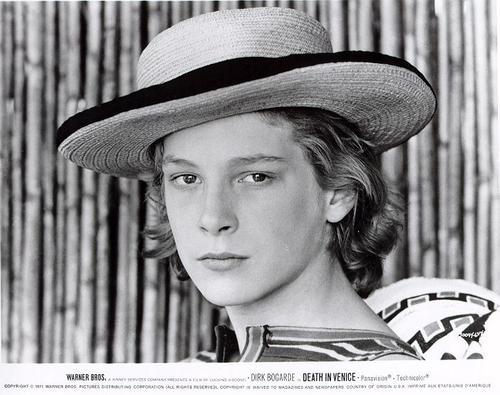
The folly of chasing beautiful blonde creatures continues in Death in Venice, a film so appalling it makes me reassess my affection for some of Visconti's other work. Dirk Bogarde's Gustav von Aschenbach seems less interested in the "ideal beauty" of Tadzio than in finding out exactly how much white makeup he can pile on his face and how heavily he can sigh into his mustache. After a long two hours of watching everyone's complexion shift from healthy to Ronald McDonald I was hissing, "Die! Die already!"

For palette cleansing, I turned to The Talented Mr. Ripley, with Tom's sumptuous, canal-side rooms a more indelible setting than anything in the aforementioned films and the blood from the razor blade darkening the waffle knit of his robe as he murmurs, "Marge..."

There's also the sweetest third in The Tales of Hoffman, when Powell and Pressburger slither through Venice, dripping with creativity. The vision is noxious: gas-green waters studded with pier pilings silhouetted to resemble gondoliers. It has magic, as black as it is, with the evil maestro casting emeralds and rubies and diamonds from wax.

So the WTT Travel Advisory is to not visit Venice though, one imagines, there might be more worthwhile films made by actual Venetians.